Cities in the Furnace: What Europe's Deadliest Summer Teaches About Urban Heat
According to a new study, more than 50,000 people died from heat in European cities in summer 2026. Cities hold on to heat, yet research shows that trees and unsealed ground can bring the death toll down measurably.
No European summer on record in such analyses has been as deadly as the summer of 2026. Researchers at Imperial College London put the figure at an estimated 50,391 heat-related excess deaths across 854 European cities from June to August, in a study for the journal Nature Health.1 By their analysis, climate change accounts for about 65 percent of these. The highest figure before that came in 2022, at about 29,500.12
These are estimates from models rather than tallies of death certificates. As the study only includes cities holding about 40 percent of the population, its authors regard the numbers as a lower bound.1
Why Cities Make Heat Worse
During the day, asphalt, concrete and glass store heat, and at night they give it back off, just when the body ought to be recovering. Because of this heat-island effect, cities are hotter than the land around them. According to calculations by the European Environment Agency (EEA) covering 820 European cities, there were 7.7 days a year on average between 2003 and 2020 when the city was over 1.5 degrees warmer than the area around it.3 The EEA says nearly half of the schools and hospitals in European cities sit inside such heat islands.4
The people at greatest risk are the elderly, small children, people with existing health conditions, and anyone living in tightly built-up neighbourhoods with no greenery.
What Has Evidence Behind It
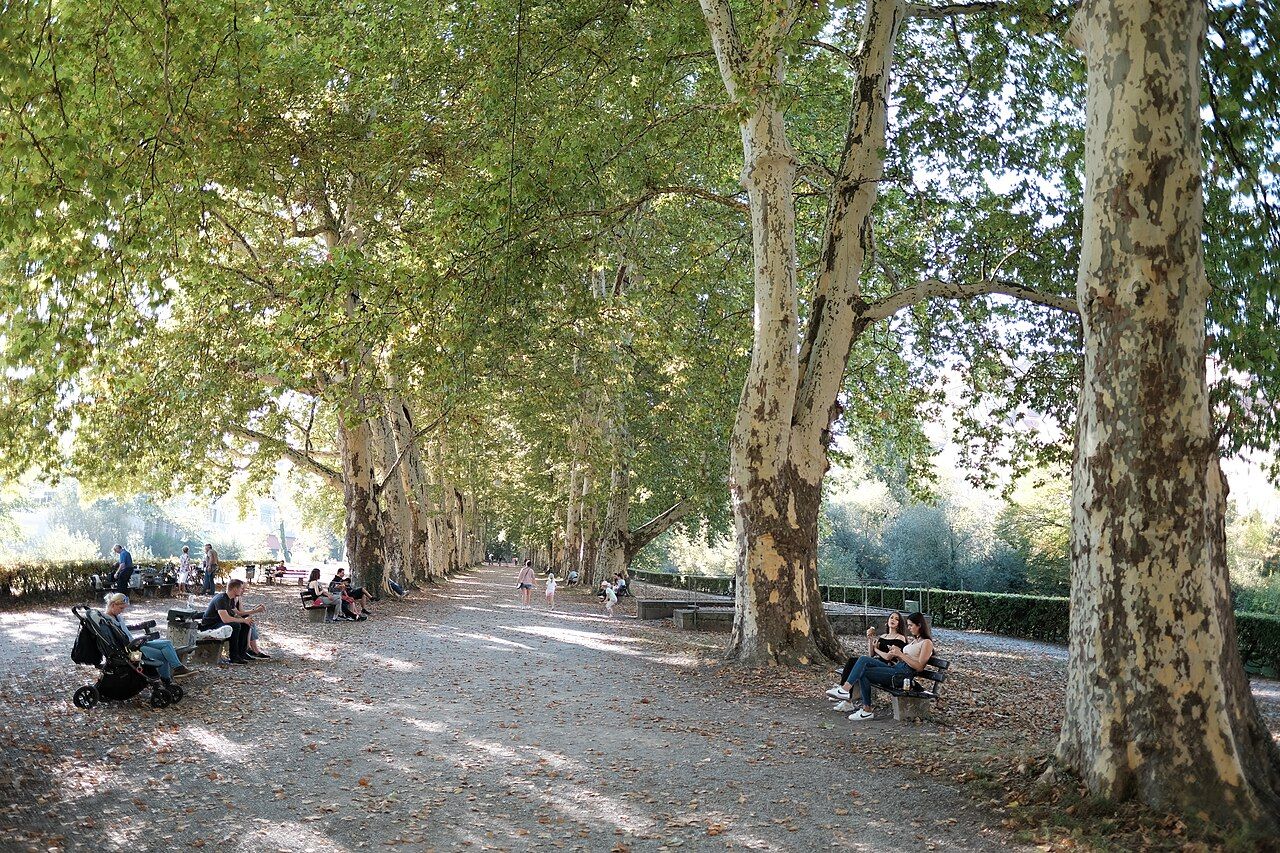
The most widely cited study on the question was published in The Lancet in 2023. Tamara Iungman and her team simulated 93 European cities and found that the cities would be 0.4 degrees cooler in summer on average if trees covered 30 percent of their area. That would have prevented 2,644 of the 6,700 premature deaths linked to higher urban temperatures in 2015, about 39 percent.5 At present, tree cover in European cities averages 14.9 percent.6
Other approaches cities are taking:
- De-sealing: When soil and plants replace asphalt, surfaces get cooler and rainwater can seep into the ground.
- Schoolyards as cool islands: Through its "Oasis" programme, Paris is redesigning schoolyards with plants, fountains and unsealed ground. By 2022, 75 yards had been redone. Measurements by Météo-France are supposed to show the effect, but results for the programme as a whole are not out yet.7
- Heat action plans: To avoid deaths in heatwaves, many cities use early warning systems, cool rooms and support for older people who live alone.
Racing the Thermometer
With climate change, heatwaves come more often, last longer and hit harder. It takes decades before trees cast real shade. What cities plant and de-seal today will decide how liveable they are in the 2040s.
Sources
- AP via WUNC: 50,000 heat deaths in summer 2026wunc.org
- Grist: Europe's deadliest summergrist.org
- EEA: urban heat island indicatorclimate-adapt.eea.europa.eu
- Reuters via Yahoo: schools and hospitals in heat islandsyahoo.com
- European Commission on the Lancet study (Iungman et al. 2023)environment.ec.europa.eu
- LSHTM on the Lancet studylshtm.ac.uk
- Climate-ADAPT: Paris Oasis schoolyardsclimate-adapt.eea.europa.eu
Found an error? We correct it and note the change. Corrections policy