The Climate Bill for Meat: What the Numbers Say About Livestock and Emissions
Farm animals occupy most of the world's agricultural land, yet they provide a small share of its calories. Fresh EU data and Denmark's planned livestock tax show where the debate is going.
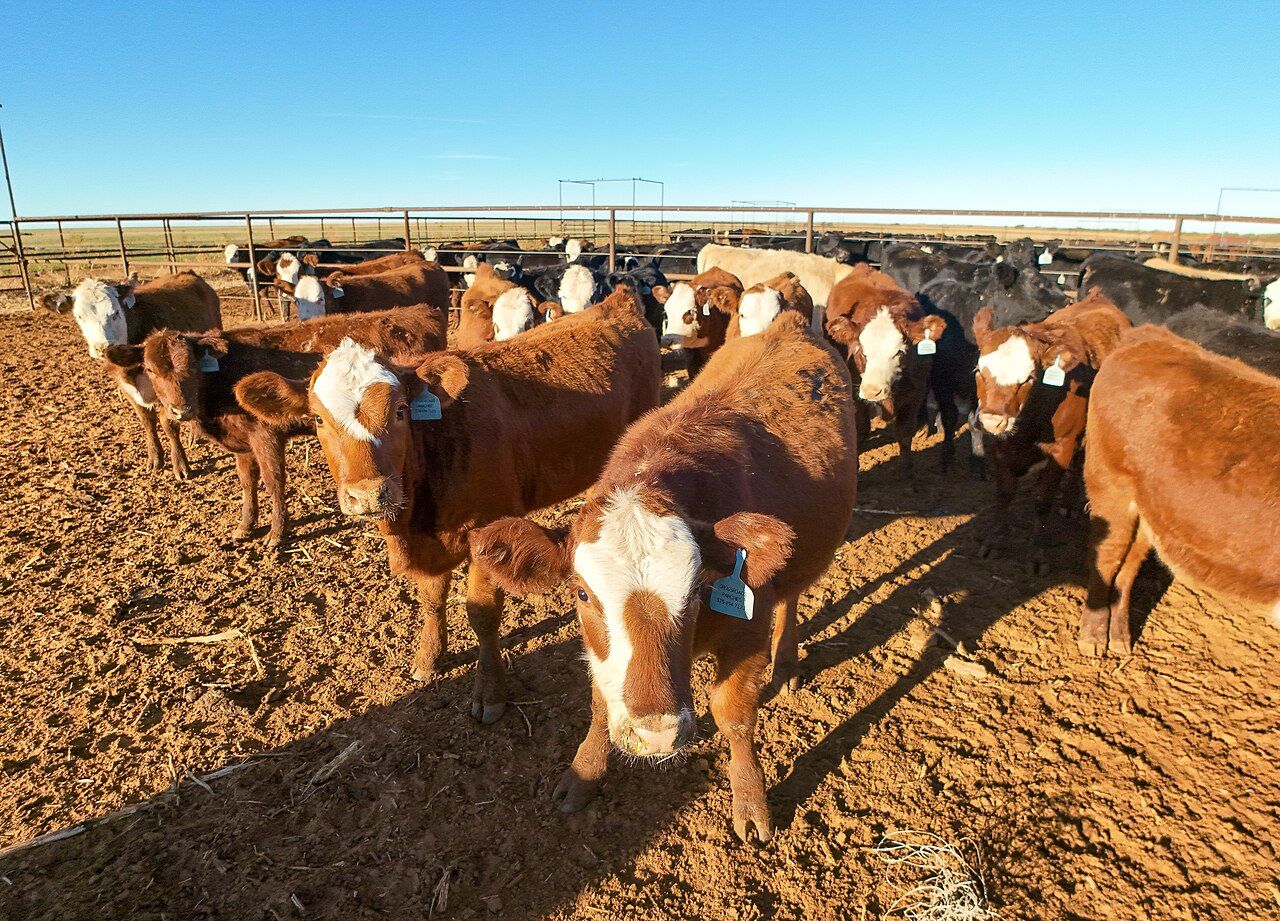
About a quarter of the world's greenhouse gas emissions come from producing food.2 One part of that stands out: the animals kept for meat, milk and eggs. They occupy most of the planet's farmland, and a large share of what they eat could have fed people directly.
How big is livestock's share?
According to the UN Food and Agriculture Organization (FAO), livestock supply chains, from growing feed and clearing land to digestion, manure and transport, produced about 6.2 billion tonnes of CO₂ equivalent in 2015. That is roughly 12 percent of all greenhouse gas emissions caused by humans.1
Cattle raised for meat and milk are responsible for 62 percent of the total. Pigs follow with 14 percent, chickens with 9 percent, buffaloes with 8 percent, and sheep and goats with 7 percent. About two-thirds of the emissions come from meat production and 30 percent from milk. A little over half is methane.1 Demand for animal products is expected to rise by 20 percent by 2050, and without further action the FAO projects livestock emissions of nearly 9.1 billion tonnes by then.1
Lots of land, few calories
Agriculture uses about 44 percent of the world's habitable land. Add grazing land to the cropland grown for animal feed, and livestock accounts for roughly 80 percent of it. Meat, dairy and farmed fish, however, supply only 17 percent of the world's calories and 38 percent of its protein.3
The contrast is starker still when emissions are measured per portion of protein. According to the meta-analysis by Joseph Poore and Thomas Nemecek, published in Science in 2018, 100 grams of protein cause the following emissions:4
| Food | kg CO₂ equivalent per 100 g protein |
|---|---|
| Beef (beef herd) | 49.9 |
| Lamb and mutton | 19.9 |
| Cheese | 10.8 |
| Pork | 7.6 |
| Poultry | 5.7 |
| Eggs | 4.2 |
| Tofu | 2.0 |
| Peas | 0.4 |
On this measure, protein from a beef herd causes more than 100 times the emissions of protein from peas.4
Why feeding crops to animals wastes calories
The biggest inefficiency is the feed itself. People eat only 48 percent of the world's cereals; 41 percent is fed to animals and 11 percent is turned into biofuels.6 A 2013 University of Minnesota study found that just 12 percent of the crop calories given to animals end up as calories in human diets. Producing a single calorie of meat can take as many as 30 calories from crops.5
By the researchers' calculation, simply switching from crop-intensive beef to pork and chicken could feed another 357 million people.5 Poore and Nemecek's data suggest, as Our World in Data reports, that if the whole world ate a vegan diet, farmland could shrink from 4.1 billion to 1 billion hectares, with cutting beef, mutton and dairy making the largest difference.6
Per kilogram, industrial production is not automatically worse for the climate. The FAO considers higher productivity and efficiency across the entire value chain the most promising route to lower livestock emissions. For pigs and chickens, the mainstays of intensive farming, most emissions come from producing feed and handling manure.1 Seen this way, the main issue with large-scale animal production is less the individual farm than the land and crops it ties up.
Europe: methane from the stable
Figures released by the European Environment Agency on 9 November show how slowly the EU is moving. Between 2005 and 2024, non-CO₂ emissions from agriculture dropped by only 8 percent. Of these emissions, 52 percent is methane from the digestion of cattle and other ruminants, 31 percent nitrous oxide from fertilised soils and about 17 percent comes from manure.7 Farming produces about 66 percent of the EU's human-made methane emissions. Under current policies, member states expect a cut of just 12 percent by 2030 compared with 2005.7
Denmark puts a price on it
Denmark, a big exporter of pork and dairy products, is the first country to tax agricultural emissions. Its parliament approved the plan in November 2024.9 From 2030, farmers will pay 300 kroner per tonne of CO₂ equivalent, and 750 kroner from 2035. With a 60 percent basic deduction, the effective rate comes to 120 kroner in 2030 and 300 kroner from 2035. Agriculture is responsible for about 28 percent of Denmark's greenhouse gas emissions.8
"Denmark will be the first country in the world to introduce a CO2e tax on agriculture," said Jeppe Bruus, the minister in charge of the agreement.9 Critics argue that it falls short. "Unfortunately, the CO2 tax is correspondingly lagging behind, as the floor deduction of 60% and large technology subsidies maintain the current intensive form of animal production," said Niklas Sjøbeck Jørgensen of the think tank Green Transition Denmark.8
The figures make clear where the leverage is: what people eat matters far more than how far their food has travelled.2 Eating less beef and dairy would free up land and feed, which is what the climate debate about livestock really comes down to.
Sources
- FAO: Pathways towards lower emissions (Dec 2023)fao.org
- Our World in Data: Environmental impacts of food productionourworldindata.org
- Our World in Data: Half of the world's habitable land is used for agriculture (2019)ourworldindata.org
- Our World in Data: emissions per 100 g of protein (Poore & Nemecek, Science, 2018)ourworldindata.org
- University of Minnesota: Cassidy et al., Environmental Research Letters (2013)sciencedaily.com
- Our World in Data: land use and plant-based dietsourworldindata.org
- European Environment Agency: greenhouse gas emissions from agriculture (9 Nov 2026)eea.europa.eu
- Carbon Brief: How Denmark plans to tax agriculture emissions (2024)carbonbrief.org
- Just Food: Denmark's livestock emissions tax approved by parliament (19 Nov 2024)just-food.com
Found an error? We correct it and note the change. Corrections policy